
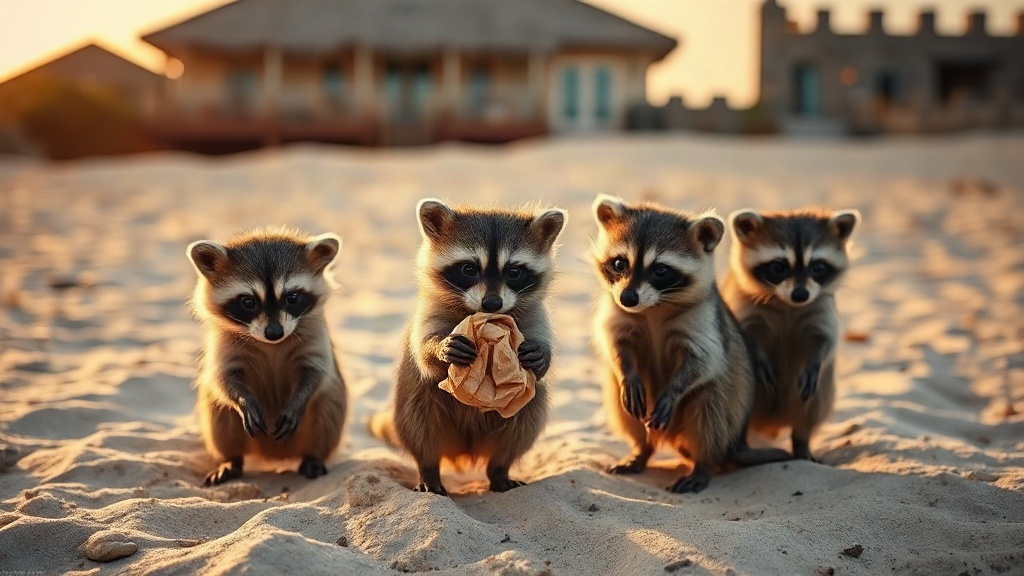
On the sun-drenched shores of Cozumel, Mexico, a remarkable scene has captured the attention of scientists: a family of pygmy raccoons, the island's endemic carnivores, gathering near a beach club not just to scavenge, but to play. They were seen fashioning balls from scraps of paper and batting them around, a behavior that suggests these animals may possess something akin to culture. The observation, made by researchers studying the raccoons' daily lives, offers a rare glimpse into the cognitive world of a species found nowhere else on Earth.
Pygmy raccoons (Procyon pygmaeus) are a critically endangered subspecies native only to Cozumel, a Caribbean island off the Yucatán Peninsula. Weighing just a few kilograms, they are smaller and more slender than their mainland cousins, the common raccoons. Their limited range and dwindling numbers make every new insight valuable, but this particular discovery goes beyond mere natural history. It touches on a question that has long fascinated biologists: do animals have culture, and if so, how does it arise?
What the Raccoons Were Doing
The behaviors were observed near a beach club, where the raccoons have grown accustomed to human presence. According to the researchers, the raccoons were not simply playing with discarded items; they were actively manipulating paper to create spherical objects, then engaging with them in what appeared to be a game. Juveniles watched adults and mimicked their actions, suggesting that the behavior was being passed down socially rather than being purely instinctual.
This is not the first time raccoons have shown surprising dexterity. Their nimble front paws, equipped with sensitive vibrissae, allow them to open latches, untie knots, and explore complex objects. But making a toy from raw material and using it for play is a step beyond simple curiosity. It implies planning, creativity, and perhaps even a rudimentary form of teaching, as younger raccoons seemed to learn by observing their elders.
Why This Matters for Animal Culture
Culture, in the biological sense, refers to behaviors that are learned from others and transmitted across generations. It is not unique to humans. Chimpanzees use tools, dolphins have sponge-foraging traditions, and some birds develop regional dialects. But documenting culture in a small, isolated carnivore like the pygmy raccoon is significant because it broadens our understanding of which species are capable of it.
"This is a clear indication that the animals have a culture," the scientists noted, emphasizing that the behavior was not a one-off accident but a repeated, socially learned activity. If confirmed through further study, it would place pygmy raccoons among a select group of animals known to exhibit cultural traits. It would also raise questions about how such behaviors emerge in small, endangered populations, and whether they can be lost if the population declines.
The Role of Play in Learning
Play is often undervalued in animals, dismissed as idle amusement. Yet a growing body of research shows that play serves critical functions: it hones motor skills, strengthens social bonds, and fosters cognitive flexibility. For the pygmy raccoons, making and playing with paper balls may be a way to practice foraging techniques or to develop the coordination needed for handling food. The fact that they do it together, in a family group, suggests that play also reinforces social cohesion.
What is striking is the use of paper, a human-made material. The raccoons are not just playing with natural objects like sticks or shells; they are repurposing our trash into toys. This adaptability is a hallmark of raccoon intelligence, but it also highlights the increasing overlap between human and wildlife spaces. On Cozumel, where tourism and development press against natural habitats, such interactions are becoming more common.
The Broader Implications for Conservation
Pygmy raccoons are listed as critically endangered by the IUCN, with a population estimated at fewer than a few thousand individuals. Habitat loss, road mortality, and introduced predators are among the threats they face. The discovery of toy-making adds a new dimension to their conservation: if these raccoons have cultural behaviors, then protecting them means preserving not just their genes but also their traditions.
Cultural traits can be fragile. If the older generation that knows how to make toys disappears, the knowledge might vanish with them. This is why long-term studies are essential. Researchers need to document how the behavior spreads, whether it varies between groups, and whether it persists over time. Such studies can inform conservation strategies that go beyond simply protecting habitat; they can aim to maintain the social structures that allow culture to thrive.
What We Can Learn from Cozumel's Raccoons
For those of us who live alongside wildlife, the Cozumel raccoons offer a lesson in coexistence. They remind us that animals are not just passive residents of our landscapes; they are active participants, capable of innovation and adaptation. The next time you see a raccoon rummaging through a trash can, consider that you might be witnessing a creature with a rich inner life, one that can turn our discarded paper into a plaything.
As scientists continue to study these island raccoons, one thing is clear: the story of animal culture is still being written, and Cozumel's pygmy raccoons have just added a fascinating new chapter.
Frequently Asked Questions
What exactly did the raccoons do with the paper?
They crafted the paper into balls and played with them, similar to how a human might crumple paper into a ball for a game. Juveniles observed and imitated the adults, indicating social learning.
Why is this considered evidence of culture?
Culture in animals is defined as behaviors that are learned from others and passed down through generations. The fact that the raccoons learned to make toys by watching each other, rather than instinctively, fits this definition.
Are pygmy raccoons dangerous to humans?
No, they are small and generally shy. However, like any wild animal, they should be treated with respect and not fed or approached too closely, as they can become habituated to human food and may lose their natural foraging skills.
How can I help protect pygmy raccoons?
Supporting conservation organizations that work on Cozumel, avoiding littering, and respecting wildlife regulations are practical ways to help. Reducing plastic waste can also prevent animals from ingesting harmful materials.
Do other animals make toys?
Yes, several species, including some primates, dolphins, and birds, have been observed playing with objects in ways that resemble toy-making. However, each case is unique, and documenting it in a critically endangered species like the pygmy raccoon is particularly noteworthy.